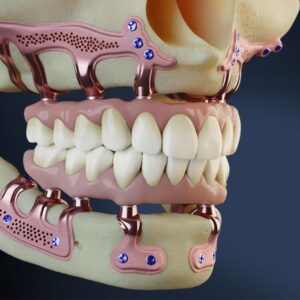
subperiosteal implants
Anisotropic Ti-6Al-4V gyroid scaffolds manufactured by electron beam melting (EBM) for bone implant applications

Arash Ataee, Yuncang Li, Darren Fraser, Guangsheng Song, Cuie Wen
Full text link: https://www.sciencedirect.com/science/article/abs/pii/S026412751730967X
Anisotropic Ti-6Al-4V Gyroid Scaffolds Manufactured by Electron Beam Melting (EBM) for Bone Implant Applications
1. Scientific Reference
- Study Title: Anisotropic Ti-6Al-4V Gyroid Scaffolds Manufactured by Electron Beam Melting (EBM) for Bone Implant Applications
- Authors: Arash Ataee, Yuncang Li, Darren Fraser, Guangsheng Song, Cuie Wen
- Journal: Not specified in the provided information.
- Year of Publication: Not specified in the provided information.
- DOI: Not specified in the provided information.
2. Scientific Background
Additive manufacturing has significantly expanded the possibilities for designing porous metallic implants intended for bone reconstruction and implant-supported rehabilitation. Among the available lattice geometries, triply periodic minimal surface (TPMS) structures—particularly gyroid architectures—have attracted considerable attention because they combine high porosity with mechanical characteristics that may better resemble those of cancellous bone.
In addition to overall strength, the directional mechanical behavior of these structures is becoming increasingly important. Manufacturing processes such as Electron Beam Melting (EBM) can introduce structural anisotropy, potentially influencing implant performance under physiological loading conditions. Understanding how manufacturing orientation affects the microstructure and mechanical response of porous Ti-6Al-4V scaffolds is therefore an important step toward optimizing future bone implant designs and improving the mechanical compatibility between implants and surrounding bone.
3. Study Objective
The purpose of this study was to investigate the influence of manufacturing-induced anisotropy on porous Ti-6Al-4V gyroid scaffolds produced by Electron Beam Melting. The authors evaluated their microstructure, compressive mechanical properties, and failure mechanisms while examining the effect of scaffold orientation and unit cell size on overall structural behavior.
4. Methodology
This work represents a preclinical materials engineering study.
Highly porous Ti-6Al-4V gyroid scaffolds with porosity levels ranging from 82% to 85% were fabricated using Electron Beam Melting technology. Three unit cell sizes—2 mm, 2.5 mm, and 3 mm—were investigated.
The authors characterized the resulting microstructure, measured hardness, evaluated elastic modulus and yield strength under compression, and analyzed failure patterns. Mechanical testing was performed on specimens manufactured in different orientations to determine how structural anisotropy influenced mechanical performance. The number of tested specimens was not specified in the available information.
5. Main Findings
Microstructural analysis revealed that the as-built struts contained orthogonally oriented martensitic α′ needles distributed within columnar grains aligned along the build direction. The average hardness reached 3.89 GPa.
Mechanical testing demonstrated that scaffold stiffness and strength depended on both unit cell size and manufacturing orientation. The elastic modulus ranged from 637 to 1084 MPa, while yield strength varied between 13.1 and 19.2 MPa.
A pronounced directional dependence was observed. Relative to specimen orientation, elastic modulus differed by approximately 70%, whereas yield strength showed a variation of approximately 49%. The authors also reported that the ratio of elastic modulus measured in orthogonal directions was comparable to that of trabecular bone.
Compression testing indicated a combination of brittle and ductile deformation mechanisms. Failure predominantly occurred through the formation of localized crush bands oriented at approximately 45° to the compression axis.
6. Clinical Interpretation
Although this investigation focuses on material characterization rather than clinical performance, it provides valuable insights into the design of porous titanium implants for bone reconstruction and implantology.
One of the most relevant observations is that manufacturing orientation substantially influences the mechanical behavior of gyroid scaffolds. This finding suggests that implant performance cannot be predicted solely from overall porosity or lattice geometry, as the additive manufacturing process itself contributes to directional mechanical properties.
The reported similarity between scaffold anisotropy and trabecular bone represents an interesting concept for future implant development. Materials exhibiting mechanical behavior closer to native bone may contribute to improved load transfer within the implant-bone interface, although this hypothesis was not directly evaluated in the present study.
Importantly, these findings should not be interpreted as evidence of improved osseointegration or superior clinical outcomes. No biological experiments, animal studies, or clinical investigations were included, and therefore the results remain limited to the mechanical characterization of the manufactured scaffolds.
7. Clinical Applications
The findings may be relevant for the development of next-generation porous titanium implants intended for bone repair, implant-supported rehabilitation, and maxillofacial reconstruction.
The study also highlights the importance of considering build orientation during the design phase of additively manufactured implants, as this parameter can significantly influence mechanical performance.
However, the available data do not establish specific clinical indications or treatment recommendations. Additional biological and clinical investigations would be required before translating these observations into routine clinical practice.
8. Level of Evidence, Limitations, and Transparency
This study should be considered a preclinical experimental investigation focusing on materials science and mechanical characterization.
Its level of evidence is limited to laboratory-based evaluation, with no in vivo or clinical validation.
The available information does not include biological assessments, long-term performance data, or clinical outcomes. Likewise, the number of tested specimens is not reported in the provided abstract.
No conflicts of interest or funding disclosures are mentioned in the available information.
9. Key Points
- Study type: Preclinical experimental materials study.
- Level of evidence: Preclinical laboratory research.
- Study population: Not specified in the provided information.
- Number of patients or implants: Not applicable.
- Follow-up: Not applicable.
- Primary outcome: Effect of structural anisotropy on the mechanical performance of EBM-manufactured Ti-6Al-4V gyroid scaffolds.
- Main finding: Mechanical properties varied substantially according to manufacturing orientation, while elastic modulus anisotropy approached that reported for trabecular bone.
- Scientific conclusion: Electron Beam Melting produces gyroid scaffolds whose directional mechanical properties are influenced by manufacturing-induced anisotropy, with potential relevance for bone implant applications.
- Limitations: Laboratory-based investigation without biological or clinical validation; additional methodological limitations are not detailed in the available information.
10. Scientific Impact
This study contributes to the growing body of research focused on optimizing porous titanium implants manufactured through additive technologies. Rather than simply describing the mechanical behavior of gyroid scaffolds, it emphasizes the importance of manufacturing orientation as a design variable capable of influencing structural performance.
The findings provide useful engineering data for researchers developing porous implant architectures intended to better reproduce the mechanical characteristics of native cancellous bone. By demonstrating measurable anisotropy associated with the EBM process, the study encourages greater consideration of build direction during scaffold design and manufacturing.
Although further biological validation remains necessary, these results establish a foundation for future investigations combining optimized lattice architectures with preclinical and clinical evaluation.
11. Editorial Conclusion
This experimental study demonstrates that manufacturing orientation plays a significant role in determining the mechanical behavior of Electron Beam Melting-produced Ti-6Al-4V gyroid scaffolds. The observed anisotropic properties, together with mechanical characteristics approaching those of trabecular bone, support continued investigation of these porous architectures for bone implant applications. Nevertheless, the findings should be interpreted within the context of a laboratory-based materials study, and additional biological and clinical evidence is required before clinical implications can be established.