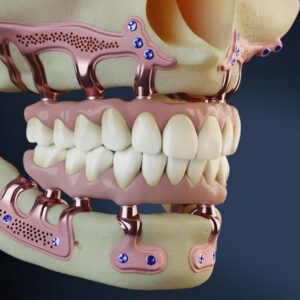
subperiosteal implants
Digitally Designed Fixed Subperiosteal Implant Solution for the Treatment of the Severely Atrophic Full-Arch with an Immediate-Load Protocol

Peter Rekawek, Ariana Etessami, Frank Tuminelli, Lukasz Skomial, Gary Orentlicher
Full text link: https://pubmed.ncbi.nlm.nih.gov/41327522/
Digitally Designed Fixed Subperiosteal Implant Solution for the Treatment of the Severely Atrophic Full-Arch with an Immediate-Load Protocol
1. Scientific Reference
- Study title: A digitally designed fixed subperiosteal implant solution for the treatment of the severely atrophic full-arch with an immediate-load protocol
- Authors: Peter Rekawek, Ariana Etessami, Frank Tuminelli, Lukasz Skomial, Gary Orentlicher
- Journal: Journal of Prosthodontics
- Year of publication: 2025
- DOI: 10.1111/jopr.70071
2. Scientific Background
Managing severe maxillary atrophy remains one of the most demanding challenges in implant dentistry. Progressive alveolar bone resorption following complete tooth loss frequently compromises the available bone volume required for conventional endosseous implant placement. In advanced cases, clinicians often face complex anatomical limitations that may necessitate extensive reconstructive procedures before implant-supported rehabilitation can be considered.
Several graftless alternatives have been introduced to reduce the need for major bone augmentation, including the use of zygomatic, pterygoid, and other anatomically anchored implants. Although these techniques have expanded treatment possibilities, they remain dependent on individual anatomical conditions and often require advanced surgical expertise. Against this background, the combination of cone-beam computed tomography (CBCT), digital treatment planning, and CAD/CAM manufacturing has enabled renewed interest in patient-specific subperiosteal implants designed to provide fixed rehabilitation in cases where conventional therapeutic options are unsuitable.
3. Study Objective
The purpose of this publication is to present a digitally planned, patient-specific subperiosteal implant concept intended for the rehabilitation of severely atrophic edentulous arches using an immediate-loading protocol. The authors describe this approach as a potential treatment option for patients in whom conventional implant-supported rehabilitation is either not feasible or contraindicated.
4. Methodology
The information provided in the abstract does not fully describe the study design. Based on the available data, the publication focuses on a digitally driven workflow incorporating CBCT imaging, computer-aided design (CAD), and computer-aided manufacturing (CAM) to fabricate custom-made subperiosteal implants.
These implants are rigidly fixed to the maxillary bone and intended to support immediate fixed prosthetic rehabilitation. The concept relies on prosthetically driven reverse planning, allowing implant design to be adapted to each patient’s anatomical characteristics.
The abstract does not specify:
- study design;
- number of patients;
- sample size;
- inclusion criteria;
- follow-up duration;
- outcome measures;
- statistical analysis.
5. Main Findings
The authors describe digitally designed subperiosteal implants as a contemporary reinterpretation of a long-established implant concept made possible by modern imaging and manufacturing technologies. According to the abstract, integrating CBCT with CAD/CAM fabrication enables the production of individualized implants that conform closely to patient anatomy while supporting prosthetically driven treatment planning.
The proposed approach is presented as an alternative for patients with severe maxillary atrophy when conventional endosseous implant therapy or other graftless solutions cannot be successfully applied. The authors also suggest potential advantages related to implant stability, reduced surgical morbidity, and improved patient satisfaction. However, no quantitative clinical outcomes or comparative data are reported in the available abstract.
Importantly, the publication acknowledges that long-term clinical evidence supporting the use of these custom subperiosteal implants for definitive fixed restorations is currently unavailable.
6. Clinical Analysis
This publication reflects the growing integration of digital technologies into complex implant rehabilitation. Rather than introducing an entirely new implant concept, the authors revisit subperiosteal implants through advances in three-dimensional imaging, digital planning, and precision manufacturing. This technological evolution may help overcome some of the limitations historically associated with conventional subperiosteal implant systems.
From a clinical perspective, the proposed workflow appears particularly relevant for patients presenting with extensive maxillary bone loss in whom traditional implant placement or extensive bone grafting procedures may not represent suitable treatment options. The emphasis on prosthetically driven planning also highlights the increasing importance of restorative considerations during implant treatment planning.
Nevertheless, the article should be interpreted cautiously. While the concept appears technically promising, the absence of long-term clinical follow-up prevents conclusions regarding implant survival, biological complications, prosthetic maintenance, or long-term functional outcomes. Consequently, the publication should be viewed primarily as the presentation of an emerging treatment strategy rather than definitive evidence supporting widespread clinical adoption.
7. Clinical Applications
Based on the information available, this digital subperiosteal implant concept may be relevant in selected clinical situations, including:
- severe maxillary atrophy associated with complete edentulism;
- patients unsuitable for conventional endosseous implant placement;
- cases where extensive bone grafting is contraindicated or undesirable;
- digitally planned full-arch implant rehabilitation;
- immediate fixed prosthetic protocols when clinically appropriate.
The abstract does not define specific patient selection criteria, contraindications, or treatment indications beyond these general clinical contexts.
8. Level of Evidence, Limitations and Transparency
The available information suggests that this publication primarily presents a technical or conceptual approach rather than a fully detailed clinical investigation. The exact study design cannot be determined from the abstract alone, making formal classification of the level of evidence impossible.
A major limitation explicitly acknowledged by the authors is the absence of long-term follow-up data evaluating definitive fixed restorations supported by these implants. Furthermore, the abstract does not report patient numbers, survival rates, complication rates, statistical analyses, or standardized clinical outcome measures.
No conflicts of interest, financial disclosures, or industry affiliations are mentioned in the information provided.
9. Key Study Highlights
- Study type: Not specified in the available information.
- Level of evidence: Cannot be determined from the abstract.
- Study population: Not specified.
- Number of patients: Not specified.
- Number of implants: Not specified.
- Follow-up period: Not specified.
- Primary focus: Digitally designed patient-specific subperiosteal implants for severe maxillary atrophy.
- Main finding: Custom CAD/CAM subperiosteal implants are presented as a potential alternative when conventional implant therapies are not feasible.
- Scientific conclusion: Digital workflows may expand treatment possibilities for severe maxillary atrophy, although long-term clinical evidence remains unavailable.
- Main limitation: Lack of long-term clinical data and limited methodological information in the published abstract.
10. Scientific Impact
This publication contributes to the renewed scientific interest in subperiosteal implant rehabilitation through the application of contemporary digital technologies. By integrating CBCT imaging, CAD/CAM manufacturing, and prosthetically driven planning, the authors demonstrate how a historically controversial treatment concept may be adapted to modern implant dentistry.
Rather than providing definitive clinical validation, the study highlights the potential role of individualized implant design in managing patients with advanced maxillary bone loss who have limited therapeutic alternatives. It also underscores the broader trend toward personalized implant rehabilitation supported by digital workflows.
The publication ultimately identifies an area requiring further investigation. Well-designed clinical studies with extended follow-up will be necessary to determine long-term implant performance, prosthetic success, complication profiles, and patient-reported outcomes before this approach can be considered an established treatment option.
11. Editorial Conclusion
This publication presents an innovative application of digital technology to the rehabilitation of severely atrophic edentulous maxillae through custom-designed subperiosteal implants. The concept offers a potential alternative for highly complex clinical situations in which conventional implant protocols may not be suitable. However, the current evidence remains preliminary, and the absence of long-term clinical outcomes limits the strength of the conclusions. Future prospective studies will be essential to clarify the long-term safety, effectiveness, and clinical role of this digitally designed implant approach.