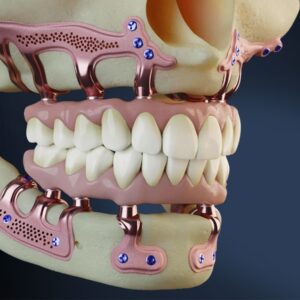
subperiosteal implants
Quality of Life Following Dental Rehabilitation with Customized Subperiosteal Implants: A Pilot Cohort Study

Evangelos Kostares, Michael Kostares, Georgia Kostare, Fani Pitsigavdaki, Ourania Schoinohoriti, Christos Perisanidis.
Full text link: https://pubmed.ncbi.nlm.nih.gov/42075648/
Quality of Life Following Dental Rehabilitation with Customized Subperiosteal Implants: A Pilot Cohort Study
1. Scientific Reference
- Study Title: Quality of Life Following Dental Rehabilitation with Customized Subperiosteal Implants: A Pilot Cohort Study
- Authors: Evangelos Kostares, Michael Kostares, Georgia Kostare, Fani Pitsigavdaki, Ourania Schoinohoriti, Christos Perisanidis
- Journal: Medicina
- Year of Publication: 2026
- DOI: https://doi.org/10.3390/medicina62040777
2. Scientific Background
Managing patients with severe alveolar ridge atrophy remains one of the greatest challenges in modern implant dentistry. In advanced cases, the available bone volume may be insufficient for predictable placement of conventional endosseous dental implants, often requiring extensive bone augmentation procedures or alternative reconstructive approaches. Recent advances in digital treatment planning, cone beam computed tomography (CBCT), and CAD/CAM manufacturing have revived interest in customized subperiosteal implants, allowing patient-specific implant frameworks to be designed according to each individual’s anatomy.
Although the renewed use of customized subperiosteal implants has generated growing clinical interest, evidence regarding patient-reported outcomes remains relatively limited. Beyond implant survival and surgical feasibility, understanding how these reconstructions influence oral health-related quality of life is increasingly recognized as an essential outcome. This pilot study therefore focuses on the patient’s perspective, assessing whether customized subperiosteal implant rehabilitation can improve daily function, comfort, and overall satisfaction in individuals with severe maxillary atrophy.
3. Study Objective
The primary objective of this prospective cohort study was to evaluate changes in oral health-related quality of life following rehabilitation with patient-specific customized subperiosteal implants in patients presenting with severe alveolar atrophy.
In addition, the investigators assessed patient satisfaction after treatment and documented short-term clinical outcomes, including postoperative complications, implant stability, and the need for secondary surgical intervention.
4. Methodology
This investigation was designed as a prospective pilot cohort study conducted at the Department of Oral and Maxillofacial Surgery of Evangelismos General Hospital in Athens, Greece.
Nine consecutive adult patients diagnosed with severe alveolar atrophy (Cawood and Howell Classes V–VI) underwent rehabilitation using customized subperiosteal implants. All implants were placed in the maxilla following digital planning based on CBCT imaging and CAD/CAM manufacturing workflows.
Oral health-related quality of life was assessed preoperatively and again at 12 months using the validated OHIP-14 questionnaire. Patient satisfaction was measured with a Numerical Rating Scale (NRS). Secondary outcomes included postoperative complications, implant exposure, implant stability, and the need for reoperation. Statistical comparisons between baseline and one-year follow-up were performed using the Wilcoxon signed-rank test.
5. Main Results
All nine enrolled patients completed the planned 12-month follow-up.
The study demonstrated a substantial improvement in oral health-related quality of life after treatment. The median OHIP-14 score decreased from 41 before surgery to 1 after one year, indicating a marked reduction in the negative impact of oral conditions on daily life. Improvements were observed across all OHIP-14 domains.
Patient satisfaction also increased considerably. The median total NRS score improved from 17 preoperatively to 58 at the 12-month evaluation. Positive changes were consistently reported for aesthetics, chewing ability, comfort, speech, prosthesis cleaning, and overall satisfaction.
Regarding clinical outcomes, no major complications were reported. One patient experienced early wound dehiscence that was successfully managed with local flap coverage, while another developed implant exposure in the anterior palate. Despite these events, every implant remained clinically and radiographically stable throughout the follow-up period.
6. Clinical Analysis
This study suggests that customized subperiosteal implants may provide meaningful functional and psychosocial benefits for carefully selected patients with severe maxillary atrophy who are not suitable candidates for conventional endosseous implant placement. Rather than focusing exclusively on implant stability, the investigators emphasized outcomes that directly reflect patients’ daily experiences, including comfort, mastication, speech, and overall quality of life.
From a clinical perspective, these findings support the concept that patient-specific digital implant reconstruction may offer a viable treatment alternative in anatomically complex situations where extensive bone grafting or other advanced reconstructive procedures would otherwise be required. The favorable short-term complication profile further reinforces the potential feasibility of this approach in selected cases.
However, the results should not be interpreted as definitive evidence supporting routine use of customized subperiosteal implants. The study enrolled only nine patients, lacked a control group, and included a follow-up limited to twelve months. Consequently, the data cannot establish superiority over other implant rehabilitation strategies or predict long-term biological and prosthetic outcomes. Larger prospective studies with extended follow-up are required before broader clinical recommendations can be made.
7. Clinical Applications
The findings of this study may be particularly relevant for clinicians managing:
- Severe maxillary alveolar atrophy.
- Completely edentulous patients who cannot undergo predictable rehabilitation with conventional endosseous implants.
- Cases requiring patient-specific digital treatment planning using CBCT and CAD/CAM technology.
- Patients for whom extensive bone augmentation procedures are contraindicated, declined, or considered excessively invasive.
Because the evidence comes from a small pilot cohort, these applications should be viewed as potential indications rather than established clinical recommendations.
8. Level of Evidence, Limitations, and Transparency
This publication is a prospective pilot cohort study, representing an observational level of clinical evidence.
The authors explicitly acknowledge several important methodological limitations, including the very small sample size (nine patients), the absence of a control group, the single-center design, and the relatively short follow-up period of twelve months. These limitations reduce the generalizability of the findings and prevent definitive conclusions regarding long-term implant performance or comparative effectiveness.
The authors report no conflicts of interest and state that the study received no specific external funding. They also emphasize that the findings should be considered preliminary and hypothesis-generating rather than conclusive.
9. Key Study Highlights
- Study Design: Prospective pilot cohort study
- Level of Evidence: Prospective observational study
- Study Population: 9 patients with severe alveolar atrophy
- Number of Implants: 9 customized maxillary subperiosteal implants
- Follow-up: 12 months
- Primary Outcome: Oral health-related quality of life (OHIP-14)
- Secondary Outcomes: Patient satisfaction (NRS), postoperative complications, implant stability, need for reoperation
- Main Finding: Significant improvement in oral health-related quality of life and patient satisfaction after one year
- Scientific Conclusion: Customized subperiosteal implants may represent a promising treatment option for carefully selected patients with severe alveolar atrophy when conventional implant placement is not feasible.
- Main Limitations: Small sample size, single-center design, no control group, short-term follow-up.
10. Scientific Impact
This pilot study contributes valuable prospective evidence to the growing body of literature evaluating customized subperiosteal implants in the digital era. Unlike many previous reports that primarily focused on implant survival or surgical outcomes, this investigation emphasizes patient-reported outcomes, providing important insight into how treatment influences quality of life, functional recovery, and overall satisfaction.
The findings support the emerging concept that successful implant rehabilitation should be assessed not only through clinical and radiographic parameters but also through validated patient-centered outcome measures. At the same time, the authors appropriately recognize that stronger evidence is still required. Larger multicenter prospective studies with longer follow-up periods will be necessary to confirm these encouraging preliminary observations, better characterize complication patterns, and establish the long-term role of customized subperiosteal implants in contemporary implant dentistry.
11. Editorial Conclusion
This pilot cohort study provides encouraging preliminary evidence that customized subperiosteal implants may substantially improve oral health-related quality of life and patient satisfaction in carefully selected individuals with severe maxillary atrophy. While the short-term clinical outcomes appear favorable, the observational design, limited sample size, and one-year follow-up require cautious interpretation. Overall, the study represents an important contribution to the evolving evidence supporting digitally planned patient-specific implant rehabilitation while highlighting the need for larger, higher-level clinical investigations.